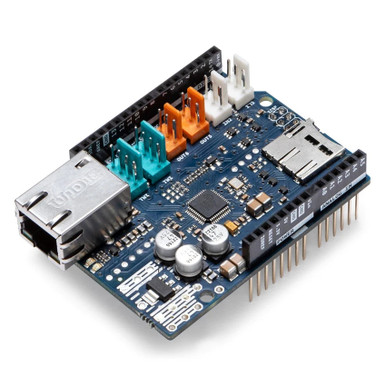
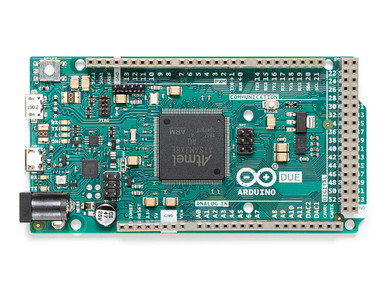
Arduino Ethernet Shield 2 | A000024 The Arduino Ethernet Shield 2 connects your Arduino to the internet in mere minutes. Just plug this module onto your Arduino Board, connect it to your network with an RJ45 cable (not included), and follow a few simple steps to start controlling your world through the internet. As always with Arduino, every element of the platform – hardware, software, and documentation – is freely available and open-source. This means you can learn exactly how it's made and use its design as the starting point for your own circuits. Hundreds of thousands of Arduino Boards are already fueling people’s creativity all over the world, every day. Join us now, Arduino is you! The Arduino Ethernet Shield 2 adds reliable wired networking to your Arduino board. It uses the Wiznet W5500 Ethernet controller and includes a micro-SD slot for storing or serving files. Key Features W5500 Ethernet controller with internal 32K buffer 10/100 Mb Ethernet via standard RJ45 jack Micro-SD card slot (access via SD library; SS on pin 4) SPI interface through the ICSP header Up to eight simultaneous TCP/UDP sockets Reset the controller for reliable power-up Stackable headers keep Arduino pinout intact Compatibility Operating voltage: 5V (from the Arduino board) Works with Arduino Uno and Mega using the Ethernet library Chip select: pin 10 (W5500), pin 4 (SD card) Note: W5500 and SD share SPI—only one active at a time Power over Ethernet (Optional Module) The shield supports an add-on PoE module (not included). IEEE 802.3af compliant, 36–57V input 12V output, overload/short-circuit protection High-efficiency DC/DC (typ. 85% @ 80% load) 1500V isolation (input to output) Note: the PoE module is third-party hardware. Indicators & Controls The reset button resets both the W5500 and the Arduino LEDs: ON (power), 13 (built-in), ACT (activity), LINK (network link) TinkerKit Connectors Two Analog Input connectors (white): A2, A3 Two Analog Output connectors (orange): PWM D5, D6 Two TWI connectors (white, 4-pin): one input, one output Resources Getting Started Ethernet Library Reference Arduino IDE Requires an Arduino board (not included).